13 May 2026

Will the laws drafted in Q1 2026 define Nigeria's economic outlook?
William Umoh
Nigeria's 10th National Assembly (NASS) in Q1 2026 (January–March) focused primarily on fiscal matters, with the 2026 Appropriation Bill as the dominant activity. Other priorities included electoral and constitutional reforms, institutional bills, and oversight, though limited sitting days (around 17 out of ~90) constrained output due to recesses and budget defense periods. Key reforms in the tax regime and electoral process also took effect, setting the tone for governance and economic management in 2026.
Key Legislative Highlights
- 2026 Budget Passage: NASS received President Tinubu’s initial ₦58.47 trillion proposal (titled “Budget of Consolidation, Renewed Resilience and Shared Prosperity”) in late 2025. It underwent second readings in January 2026, with committee scrutiny and MDA defenses. By late March (around March 31), both chambers passed a significantly revised version totaling ₦68.323 trillion, an increase of over ₦9 trillion. The budget hike signals a shift toward capital-heavy spending. President Tinubu signed the main budget in mid-April 2026. NASS also handled the FCT 2026 Appropriation Bill (~₦2.2 trillion).
- Electoral and Constitutional Reforms: Significant progress was made on Electoral
Act amendments and Constitutional review (1999 Constitution alterations) advanced, with reports expected or laid in Q1 on issues like state police, local government autonomy, fiscal federalism, and gender provisions. Electoral/constitutional moves target.
- Other Bills and Reforms: NIMC Act (identity management), Police Trust Fund
amendments, health/judicial reform bills, NAfDAC and other agency amendments, establishment bills (e.g., colleges, institutes), and National Assembly-related administrative bills were also considered.
Overall, legislative productivity appeared moderate to low in volume due to the budget cycle and the recurrent recess. Factors such as limited plenary days, political dynamics ahead of the 2027 elections, and defections influenced focus and broader legislative output.
Quarter at a Glance
|
Metric |
Value |
Remarks |
|
2026 Budget Approved |
₦68.3 trillion |
Increased by ₦10.12 trillion from the initial proposed amount |
|
External Loans Approved |
$6 billion |
TRS + UKEF facilities |
|
Landmark Acts Signed |
6 |
Electoral Act & Tax Reforms Act |
Key Legislative Timeline – Q1 2026
-
- 1 January 2026 – Four Tax Reform Acts take effect (Nigeria Tax Act, Tax Administration Act, Nigeria Revenue Service Act, Joint Revenue Board Act)
- 17 February 2026 – National Assembly passes harmonised Electoral Act (Repeal & Re-Enactment) Bill 2026
- 18 February 2026 – President Tinubu signs the Electoral Act 2026 into law
- 24 March 2026 – President transmits $6 billion external borrowing request to NASS
- 31 March 2026 – Passage of ₦68.3 trillion 2026 Budget and approval of $6 billion loans
Legislative Oversight Highlights & Concerns Positive Notes:
-
- Swift passage of critical fiscal documents
- Extension of 2025 capital projects implementation to 30 June 2026
- Continued tax reform implementation
Areas of Concern:
-
- Rapid approval of a $6 billion loan within 7 days
- Alleged inadequate scrutiny of new debt facilities
- “Zero capital release” issues raised during budget defence
- Civil society criticism of the Electoral Act passage as rushed
Major Sector Allocations (Selected)
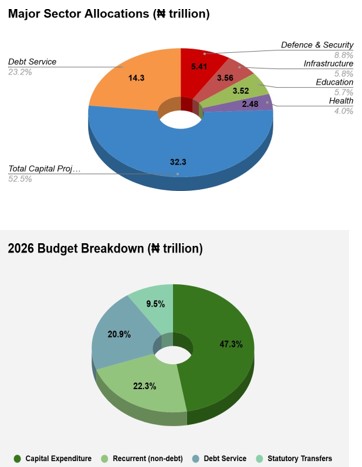
Nigeria's Q1 2026 legislative environment tells a story of a government that is fiscally ambitious, reform-oriented in intent, and politically consolidated, but operating with oversight deficits and implementation constraints that introduce meaningful execution risk. The data shows budget dominance (>70-80% of high-level activity), with reforms as secondary. Q1 set a fiscally ambitious tone for 2026, prioritising infrastructure-led recovery amid reforms, while highlighting the need for better oversight and implementation discipline.
The political dynamics ahead of the 2027 elections have significantly influenced legislative focus and output. This is a standard feature of Nigeria's political economy, but it has concrete business implications: procurement decisions, regulatory appointments, and policy priorities in Q2–Q4 2026 will increasingly be filtered through electoral calculus.
For investors and business leaders, the opportunity is real, and the direction is right; the discipline required to translate legislation into economic outcomes is where the bet actually sits.
Umoh is the Legislative Reform Analyst, Ernest Shonekan Centre